|
What does it mean to have a "Chakra Balancing"? This is first in a series of information about Chakras that will include their association to our health and how we are affected when they are balanced or unbalanced.
What's a Chakra?
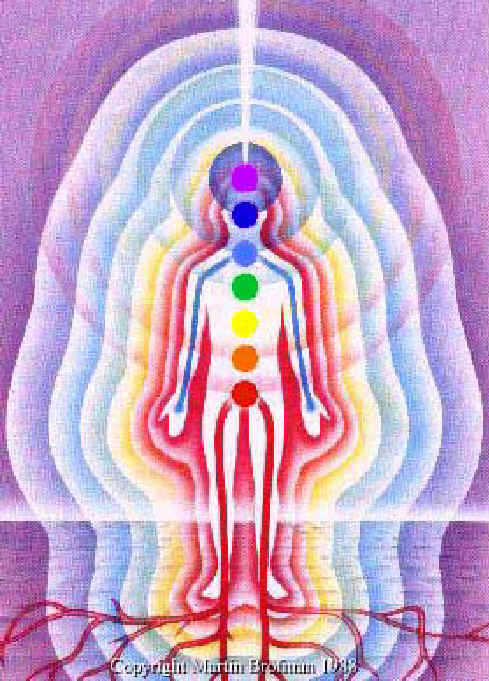
Chakra is a Sanskrit word meaning wheel, or vortex, and it refers to each of the seven energy centers of which our consciousness, our energy system, is composed.
These chakras, or energy centers, function as pumps or valves, regulating the flow of energy through our energy system. The functioning of the chakras reflects decisions
we make concerning how we choose to respond to conditions in our life. We open and close these valves when we decide what to think, and what to feel, and through which perceptual filter we choose to experience the world around us.
The chakras are not physical. They are aspects of consciousness in the same way that the auras are aspects of consciousness. The chakras are more dense than the auras, but not as dense as the physical body. They interact with the physical body through two major vehicles, the endocrine system and the nervous system. Each of the seven chakras is associated with one of the seven endocrine glands, and also with a group of nerves called a plexus. Thus, each Chakra can be associated with particular parts of the body and particular functions within the body controlled by that plexus or that endocrine gland associated with that
Chakra.
All of your senses, all of your perceptions, all of your possible states of awareness, everything it is possible for you to experience, can be divided into seven categories. Each category can be associated with a particular
Chakra. Thus, the chakras represent not only particular parts of your physical body, but also particular parts of your consciousness.
When you feel tension in your consciousness, you feel it in the Chakra associated with that part of your consciousness experiencing the stress, and in the parts of the physical body associated with that
Chakra. Where you feel the stress depends upon why you feel the stress. The tension in the Chakra is detected by the nerves of the plexus associated with that
Chakra, and transmitted to the parts of the body controlled by that plexus. When the tension continues over a period of time, or to a particular level of intensity, the person creates a symptom on the physical level.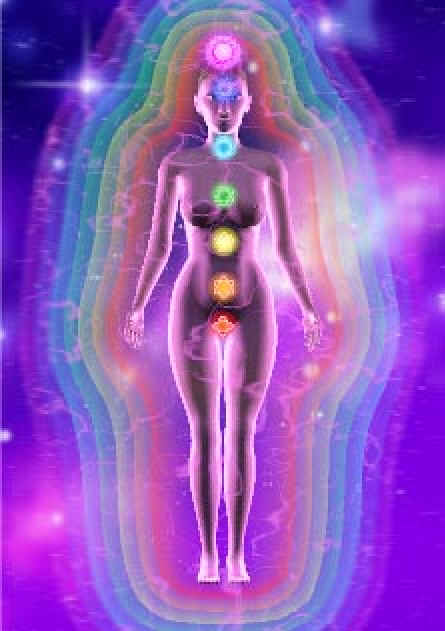
The symptom speaks a language that reflects the idea that we each create our reality, and the metaphoric significance of the symptom becomes apparent when the symptom is described from that point of view. Thus, rather than saying, "I can't see," the person would describe it as keeping themselves from seeing something. "I can't walk," means the person has been keeping themselves from walking away from a situation in which they are unhappy. And so on.
The symptom serves to communicate to the person through their body what they had been doing to themselves in their consciousness. When the person changes something about their way of being, getting the message communicated by the symptom, the symptom has no further reason for being, and it can be released, according to whatever the person allows themselves to believe is possible. We believe that anything can be healed. It's just a question of how to do it. Understanding the chakras allows you to understand the relationship between your consciousness and your body, and to thus see your body as a map of your consciousness. It gives you a better understanding of yourself and those around you.
More about Chakras with their individual locations and functions in our next publication.

Deep Tissue Issues
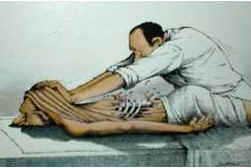
"Deep Tissue" has become a generic term used to label any heavy pressure massage. In truth, Deep Tissue Massage is a very specific massage technique. Deep Tissue therapists look for shortened muscles and/or distorted postural patterns. With slow deep strokes, the therapist works to lengthen the muscle fibers, to restore balance, and to reestablish structural and functional integrity to the greatest degree possible for the client. Deep Tissue Massage increases range of motion and restores economy of motion.
The confusion may arise from the fact that the goals of most massage therapies are to lengthen shortened muscle fibers, increase range of motion and ease of movement, and to restore balance. Deep Tissue work is not always the best way to achieve these goals.
It's important for the therapist to understand there where there is a short, tight muscle, there is also at muscle that is too long or weak.
If the mast to a sail boat is leaning, it doesn't help when we lengthen the short rope. The only way to bring the pole back onto balance is to tighten the slack rope as well as lengthen the tight rope. The same is true with our muscles. It is this lack of balance between the agonist and the antagonist that distorts our posture and eventually leads to patterns of pain.
It's important to be specific in massage and bodywork when there is an imbalance of muscle tone. That is why it is rare that I perform the exact therapy to both sides of the body and why many times you find that I may be working on the chest muscles to help regain balance to those tight, achy muscles between your shoulder blades.
Back to 
|
|
There are two primary directions we can take to improve the quality of life. We may attempt to make external conditions match our goals, or we can change how we experience external conditions to make them better fit our goals. For example, to feel secure is an important part of happiness. We may feel more secure by buying a gun, installing a quality security system, or moving to a safer neighborhood. All of these are attempts to bring our environment more in line with our goals. Or, we can modify or change our meaning of the word security. If we do not expect perfect security, if we recognize that risks are inevitable, and allow ourselves to enjoy a less than ideally predictable world, then the threat of insecurity will not have much of a chance to negatively affect our happiness.
Oddly enough, neither of these strategies is effective by themselves. Changing external conditions may seem to work at first, but unless we are in total control of our consciousness, the old fears and desires will return to haunt our feelings of security again.
Wealth, power, and status have become the symbols of happiness in our culture. The waiting rooms of psychiatrists are filled with rich and successful patients who, in their forties and fifties, suddenly wake up to the face that their plush suburban home, expensive cars, and Ivy League education are not enough to bring peace of mind. Yet they keep thinking that changing the external conditions of their lives will provide a solution. When we see people who are rich, good looking, or famous, we tend to assume that their lives are rewarding. And we assume that if only we could acquire some of those same symbols, we would be much happier.
But symbols can be deceptive: they have a tendency to distract from the reality they are supposed to represent. The reality is that the quality of life does not depend directly on what others think of us or on what we own. The bottom line is, rather, how we feel about ourselves and about what happens to us. To improve live we must improve the quality of experience.
Based on these observations, instead of worrying about how much money we can make or how to win friends and influence people, it would be more beneficial to concentrate on how everyday life can be more harmonious and more satisfying, and thus achieve a more direct route what cannot be reached through the pursuit of symbolic goals.
"Pleasure is a feeling of contentment that one achieves whenever information in consciousness says that expectations se by biological programs or by social conditioning have been
met." Pleasure is an important component of the quality of life, but by itself cannot bring happiness. When we think back about what makes our lives most rewarding, we tend to remember events that overlap and go beyond pleasure, to enjoyment.
Enjoyment is quite different than pleasure, even though all enjoyment is pleasurable; all things pleasurable are not enjoyable. Enjoyment denotes a sense accomplishment. After an enjoyable even, we know we have changed, that we have grown, become more than who we were.
Here's the key. A person can experience pleasure without any effort, if the appropriate centers in the brain are stimulated either electrically or chemically. But it is impossible to enjoy a tennis game, a book, or good conversation unless our attention is fully concentrated on the activity.
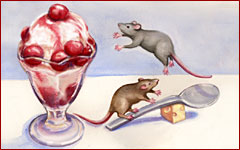 There is one thread woven through virtually all enjoyable experiences: the activity must be complex, challenging and require an appropriate level of skill. There is one thread woven through virtually all enjoyable experiences: the activity must be complex, challenging and require an appropriate level of skill.
Ever wonder why children seem to enjoy life so easily? Almost everything is a challenge and new. They are constantly learning and each instance of enjoyable learning adds to the complexity of the
child's developing self.
Sadly enough, this natural connection between growth and enjoyment tends to disappear with time. Without enjoyment life can be endured, and it can even be pleasant, depending on luck and the cooperation of the external environment. But to gain personal control over the quality of our experience, we need to learn how to build enjoyment into our everyday lives, day in and day out.
Sometimes a person reports having an experience of extreme joy, a feeling of ecstasy for no apparent reason: listening to music may trigger it, or a wonderful view, or even less
-- just a spontaneous sense of well-being. But by far the most overwhelming proportions of optimal experience are reported to occur within the sequences of activities that are both goal-oriented and bound by rules
-- activities that require an investment of psychic energy, and could not be done without the appropriate skills.
It's important to understand that an activity need not be active in the physical sense, and the skill need not be a physical skill. Reading is a good example of an activity because it requires the concentration of attention and has a goal and to do it we must know the rules of written language and much, much more.
The most important thing to remember about enjoyment is that there must be a challenge that requires the appropriate skills. If we
don't have the right skills, the activity is not a challenge. Setting up a chessboard gets the juices flowing for a chess player, but leaves a person cold if they
don't know how to play chess.
The eight major components of enjoyment:
What we do, our activities, has less to do with enjoyment than how we feel. Even though there must be a challenge for an activity to be truly enjoyable, studies have shown that there are eight major components of enjoyment. When people reflect back on how they feel when their experiences have been most pleasant, they usually list one or many times all of these components.
1 There is a good chance of completing the task
2 We are able to concentrate
3 We have clear goals
4 There is immediate feedback
5 There is deep but effortless involvement that removes the awareness of worries and frustrations of everyday life.
6 There is a sense of self-control over our actions.
7 Concern for ourselves disappears, yet the sense of self is stronger afterward.
8 The sense of the duration of time is altered. Hours pass in minutes and minutes can seem like hours.
How we feel moment to moment is so important to our holistic health. Every thought we have has a physiological response; i.e. our brain and body will respond to our thoughts. Science is learning that disease is always linked to some degree to who we feel and what we think. The best advice we can give to ourselves is to ask ourselves on a continual basis: does this support who I want to be? One of the most common patterns of non-support I see on my table is the lack of joy, happiness and pleasure!
As soon as we accept that we are responsible for our own happiness, we can then take the necessary steps to a more enjoyable experience. Even the most mundane activity can be enjoyable as long as we are creative. Invent ways to bring enjoyment into your daily activities. Have fun with it; you deserve it! ENJOY!
|
|
When you spend a lot of time in the car, your posture can become slumped, which leads to sore neck and shoulders. A good way to remind yourself to sit up straight is to adjust your rear-view mirror while you are in a comfortable straight posture. When you check your mirror and cannot see out of it, you are slumping, and need to straighten to see out of it.
A gift certificate for Massage is less fattening than chocolate.
Whatever the occasion, a gift certificate for a massage is always welcome! Birthday, anniversary, wedding, bridal attendants, best man, new job, graduation, whatever the occasion, it will be appreciated. And don't forget to treat yourself. We can set up gift certificates in any denomination you choose.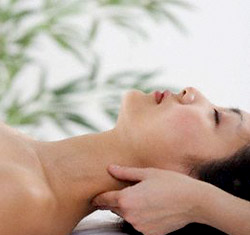
Headache Cure Technique
Spend a moment to get in touch with the headache. Notice how it feels.
Pretend you have a lump of clay in your hands, which can be any color you want. This clay is going to become an external representation of your headache as we go through the exercise.
Make the clay into a color that matches your headache, if it were externalized from yourself. It might be all one color, a mixture of colors, or it could be constantly changing. Notice whether it changes brightness.
Make the clay an appropriate size and shape, including lumps, bumps, spikes, holes, etc. Notice whether it throbs, or changes shape over time. I wonder if it also moves its location as well, or maybe even its size?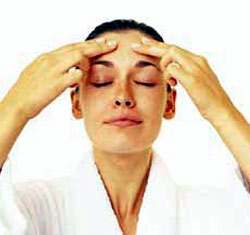
Notice whether it feels hot or cool, damp or dry, rough or smooth.
Notice any sounds it makes - where are the sounds coming from, what sort of pitch and volume are they? You might also notice if they change volume or intensity over time.
Gradually begin to soften the color and brightness, and begin changing any sharp corners into rounded ones, whilst lessening the height of any spikes and bumps. And then begin to slow down any movement it has so that it is stationary, and slow any throbbing down until is unchanging in size and shape.
Change the texture to make it more peaceful and calming.
Allow the sounds to become quieter, more muffled, and less piercing, as they become centered on the item in your hands.
Continue shrinking the item until it is small enough to hold between your thumb and fore finger, and then flick it away, way over the horizon.
Did you know?
Non-dairy creamer is flammable.
EUCALYPTUS: Eucalyptus globulus,
Eucalyptus Radiata Eucalyptus, Lemon (Citridora):
Strong camphor like, balsamic, fresh scent. Soothes inflammation in respiratory
passageways, bronchitis, fights viruses and bacteria while easing congestion,
also helps asthma. Clears the head especially when used with Rosemary and
Peppermint essential oils. Can be helpful for muscular aches and pains, used in
massage or bath.
Complimentary Services
Environmental Sounds:
Environmental sounds are available upon request at no additional
charge. Enjoy soothing sounds that are most pleasing to YOU.
Rainfall: Ease the mind with the peaceful patter of rain.
Ocean Waves: Wash away tension with the calming effect of
the tide.
Summer Night: Create a relaxing atmosphere with the gentle
sounds of the evening.
Waterfall: Provides an ideal working background with the
refreshing cascade of falling water.
Running Stream: Soothe your soul with the serenity of a
floating stream.
Tropical Forest: Travel to a world full of tranquil
tropical sounds.
Songbirds: Awake to the sensation of birds harmoniously
singing.
Thunderstorm: Lull yourself to sleep with the rumbling of a
thunderstorm.
Also:
Topical analgesic ointments
Cool, Soothing Eye Pillow
Add-on Services:
Add any of these services to your massage where they are not
included.
Aroma
Therapy: $5
Trigger point Therapy: $5
Chinese Abdominal Massage: $10
Cupping: $5
Ice: $15
Heat: $15
Educational Stretching: $15
Educational Exercises: $15
First Visit Consultation: $15
|
Please arrive 15 minutes early for each appointment. You
must be in the treatment room at your scheduled massage time to get the
full benefit of each session.
Cancellation Policy:
Please grant CHI the courtesy of a 24-hour notice in order for us to book
other clients in need of service. There is a charge for appointments
cancelled with less than 24-hours notice.
|