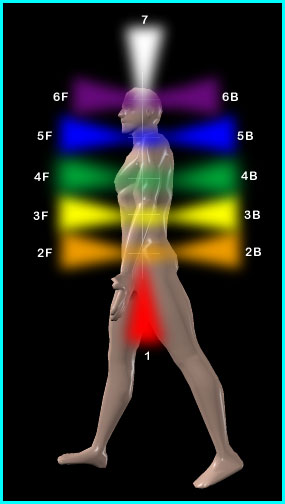
Root Chakra
Also known as Security Center, Muladhara
Body/Mind Associations:
Location: The perineum, the point between the anus and the sex organs
Color: Red
Parts of the body: Lymph system, skeleton system (teeth and bones), the prostate gland in men, the sacral plexus, the bladder and elimination system, and the lower extremities (legs - feet, ankles, etc.). Also the nose, since it is the organ of the sense of smell, is associated with survival.
Endocrine gland: Adrenal glands
Sense: Smell
Consciousness: Security, survival, trust, the relationship with money, home, job. Ability to be grounded, to be present in the here and now.
Root Chakra
Ability to allow one's self to be nourished, in the sense of allowing one's Inner Being to be satisfied. This chakra also reflects a person's connection with their mother, and with Mother Earth, how the person feels about being on the earth, and connection with the physical body.
Symptoms or tensions in the parts of the body controlled by this chakra indicate tensions in the parts of the person's consciousness related to this
chakra. Tension here is experienced as insecurity as a general perceptual filter. More tension is experienced as fear. More than that is experienced as terror, or a threat to survival.
Element: Earth
The Root Chakra is associated with the parts of our consciousness concerned with security, survival, or trust. For most people, this concerns the parts of their consciousness concerned with money, home, and job. When this chakra is in its clear state, the person is able to feel secure, be present in the here- and-now, and be grounded. When there is tension in this
chakra, it is experienced as insecurity or fear. When there is more tension, it is experienced as a threat to survival.
Parts of the body controlled by the sacral plexus and the root chakra include the skeleton system, the legs, and the elimination system. Symptoms in these parts of the body represent, therefore, tensions at the level of the Root
Chakra, and we therefore know that the person is seeing the world through a perceptual filter of insecurity or fear. The adrenal glands are also associated with this
chakra.
If one leg is affected, we can see whether it is the male leg or the female leg, and thus whether it has something to do with trust in a male or trust in a female. We can also see it as having something to do with trust in the will, or the aspects of trust in the foundations of the emotional being, related to what was happening in the person's life at the time the symptom developed.
The physical sense of smell, and therefore the organ of the sense of smell, the nose, is associated with the Root
Chakra. Symptoms at the level of the nose or affecting the sense of smell reflect tensions at the level of the Root
Chakra.
Each chakra is associated with an element. The Root Chakra is associated with the element of earth, and reflects something about the person's association with the earth, or how they feel about being on the earth, which we call Mother Earth. This chakra is also associated with our relationship with our mother. When someone experiences a sense of separation from their mother, or not feeling loved by their mother, they cut off their roots and experience symptoms of tensions at the level of the Root Chakra until they can again open to accept their mother's love.
When a child comes into the world in the traditional family structure, the mother provides the nourishment and the father provides the direction. Thus, in the child's relationship with its mother, it makes certain decisions about the way things are. The relationship with the mother thus becomes a model for the person's relationship with everything that represents security (money, home, and job).
Sacred Movement Therapy
Excellent detoxing therapy. This healing bodywork technique was developed at CHI and is unique in that it addresses six essential components of the body: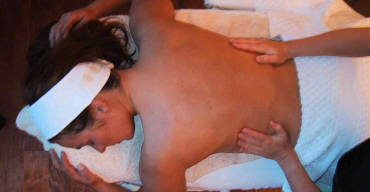
The Joints
The Lymph
The Blood
The Organs
The Muscles
The Chi Energy
Sacred Movement Therapy begins with rhythmic movement of the sacrum that creates an energy vibration throughout the entire body. The movement continues throughout the massage, stimulating the flow of chi, blood, and lymph as every muscle is gently relaxed. Every joint is passively manipulated and lubricated to bring about a feeling of openness. Toward the end of the massage, a Chinese abdominal technique soothes the organs and activates the flow of chi from the tan tien (vital energy center). This massage is performed on the bare skin with little or no lubricant.
Joe's Tips
Most of the time low-back pain when sitting is caused by stress upon the joints, ligaments and muscles because we are sitting on our legs more than we are on our butt. We are designed to sit on our "seat-bones", but almost no one in our culture does. By sitting with so much of our weight resting on our legs, pressure is transferred from our legs to our low-back. This causes our structure to be out of alignment with gravity.
To eliminate the pain, position yourself on the front edge of the chair so that your "seat-bones" are resting firmly on the chair. Adjust your chair height so that your knees are a few inches higher than your hips. The pain will usually be gone instantly.
This does not mean there isn't a problem in your low back, only that you can now sit in comfort.
Did you know?
Security does not exist in nature!
Attitude
The degree of importance placed on any given task sets the stage for determining one's attitude. Our attitude controls how the body and mind function. Even though a person may be very proficient at a given task, it is the attitude while performing the task that determines whether the desired results are acquired. Attitude can outweigh experience!
Imagine walking across a two-inch wide beam, suspended eight inches above the ground between two concrete blocks. To determine how well we do, we keep score, adding one point to each person's score if they fall, until every person has crossed the beam twenty times without falling. Here the importance placed on not falling and getting the best score sets the attitude for the game. The value placed on winning the game will have a definite effect on performance.
If we change the rules somewhat, we get a different result. This time, we say that anyone who falls must pay the others in the game $10. Though no other parameters change, some people will have problems crossing the board without falling because the importance placed on the outcome has increased and therefore affects the performance of the players.
To carry this example to extremes, change the rules again. If the same beam were placed thirty feet above the ground, imagine what would happen. Even though every player had previously crossed the same board twenty times without falling, very few, if any, would be willing to cross the beam. The body will not function properly when the risk becomes too great. This happens to many of us on an ongoing basis. We place too much importance on what we do, what others may think, even on our health.
This is what I call the attitude of the Extremist. Many of my students place themselves in this situation every time they come to class by placing so much importance on the outcome of what they are practicing. They place so much emphasis on getting everything perfect that the body and mind cannot function. They try so hard that nothing seems to work; it becomes impossible to relax and perform at their optimal level.
It's important to be aware that it is OK to make mistakes. It*s actually GOOD to make mistakes! Growth comes from trial and ERROR. Analyzing is great but to be over analytical stagnates progress. Most of what we do every day must be felt. It requires us to experience the sensation and grow accustomed to how things feel. No amount of reading, thinking or analyzing can prepare one to perfectly synchronize the gas and the clutch of a car if you have never driven. It is something that must be felt and experienced. Learning to relax and take care of ourselves is also something that must be felt and experienced by the mind and the body.
The Pessimist wills himself to fail by constantly saying "I can't do it"; or "why can't I do it"? The mind is very proficient at providing answers to all questions, regardless of how ridiculous they may actually be. Ask questions that will stir the imagination toward a positive mental attitude. Turn "I can't do it " into "I can't do it, YET"!
Avoid the word try. Replace it with the word do. To try something is to not do it! The moment we succeed, we have done it. The only time we can say we tried something, is when we have failed. The more we use the word try, the more failure is reinforced.
Get in the habit of asking positive questions about who you are, what you want, and how you can feel better. This will keep you focused on solutions, not problems.
Questions like: "What's not perfect about this diet yet"? or "How can I feel better and enjoy the
process?" or "What type of activity can I do that will be fun?"
Attitude is controlled by awareness.
Awareness is the result of what we're focused on.
What we're focused on becomes our reality.
If we want to be down, depressed, spiritless; it's easy, focus on everything bad in our life. But, if we want to be up, happy, and full of spirit; that's easy too, focus on the good in our life.
We change our reality by changing our attitude.
We change our attitude by changing what we're aware of.
We change what we're aware of by changing our focus.
We change our focus by changing the questions we ask ourselves.
Consistently ask questions that force you to focus on things that make your reality more pleasant. Do it in a way that becomes very natural and normal.
Water: Nature's Medicine
Did you know that pure water can be used in place of many of the over the counter and prescription drugs?
Have you ever seen a wilting house plant, kept half alive, never getting all the water it really needs to look its best? Your body is just like that plant, wilted, if you don't drink enough pure water. Next to oxygen, water is the most important nutrient for life.
Over two thirds of your body is made up of water, our muscles are 78 percent water, and our brain, the most vital organ, is approximately 85 percent water. Despite how vital this substance is to our health and survival, most of us do not drink enough water to enjoy the best of health. Coffee, tea, sodas and other liquids do not have the same properties as plain, pure water. In fact most of us drink more fluids each day that act as diuretics, than we drink of pure water each day. Diuretics cause our bodies to eliminate more water.
None of us would consider driving our automobiles with less than adequate cooling in the radiator, yet without the proper amounts of water in our bodies, our cells are continually burning up due to over heating.
Massage for Couples
Saturday, November 12, 2005
This short course is an ideal introduction to the world of Massage. It is an opportunity for you to exchange some massage with your partner under some expert guidance.
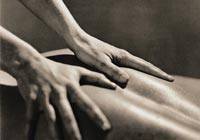
The skin is the largest sense organ of the body, thereby explaining why we have such a strong, innate need for touch. Yes, we all have the "need" for touch. Consider how a child is reassured by a warm hug, how holding the hand of a loved one brings feelings of comfort, or how a backrub eases away tension. The simplest physical contact can trigger emotional and mental connections in return.
The Basic Strokes
 | The Welcoming Press |
| The Musclewarmer |
| Kneading |
| Ringing |
| Flicking |
| Ironing |
| Drumming |
There are no hard and fast rules about non-therapeutic massage, just an overall guiding principle: If it feels good, and it's safe, do it.
Besides learning how to give a soothing, relaxing massage you will learn the proper methods of massage that will not leave you fatigued. Massage for couples is intended to soothe all of your senses. The TOUCH of your partner on your skin and muscles is only a part of the experience.
| SOUND, |
| SCENT, |
| SIGHT & |
| MORE -- There's always more to explore. |
Some of the positive effects of massage for couples:
Learn to give an effective massage using proper body mechanics to avoid feeling fatigued after only a few minutes of
massage.
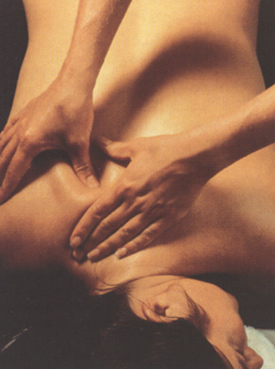 The fulfillment of one of your most basic human needs
(contact).
The fulfillment of one of your most basic human needs
(contact).
The satisfaction in knowing you are doing something good for your mind and body.
The reduction of the effects of stress on the body (which in turn removes your perception that you feel
stressed).
Softer, healthier skin -- Oil and friction remove the external layer of dry, dead skin all over your body, leaving a new layer of fresh, healthy
skin!
For information on how you can participate in this special workshop, contact Louisa for details!
704 895-6788
Back to 